

What if your next 10x return isn’t hidden in a spreadsheet, but in a story waiting to be told? How does that sound?
As a private equity firm, your greatest differentiator to win isn’t just the money. It’s the clarity you bring with branding that creates a positive perception because the market is already flooded with capital.
As long as your private equity firm neglects branding, then you are leaving much on the table.


Your strong, clear brand is a strategic asset for your private equity firm.
Why? Today, Limited Partners, in-demand dealmakers, and management teams are attracted to private equity with a unique identity.
If you’ve done your branding right, then it builds an irresistible firm identity, attracting the right deals, speeding up value creation, and optimizing exit multiples.
In a nutshell, branding converts your private equity firm from a cost center into your most powerful multiplier.
This quick read will help you understand the value of branding private equity and how to do it effectively to make a lasting impact. Let’s get off the mark.
What is Private Equity Branding?
Private equity branding is the strategic process of building a unique identity and powerful reputation in the minds of stakeholders. It gives your private equity an advantage over your competitors.
In essence, it’s the process that answers a critical question: “Why should anyone choose us, beyond the price of our capital?”
While the private equity brand strategy attracts the right partner, accelerates growth, leads to premium prices, and builds a more valuable asset for exit.
All in all, it’s the intentional move from being just a source of capital to becoming a partner of choice and a builder of value.
You can see popular brands owned by private equity, such as Getty Images, which is held by the private equity firm Hellman & Friedman, and Staples, purchased by Sycamore Partners.
5 Important Strategies for Branding Private Equity
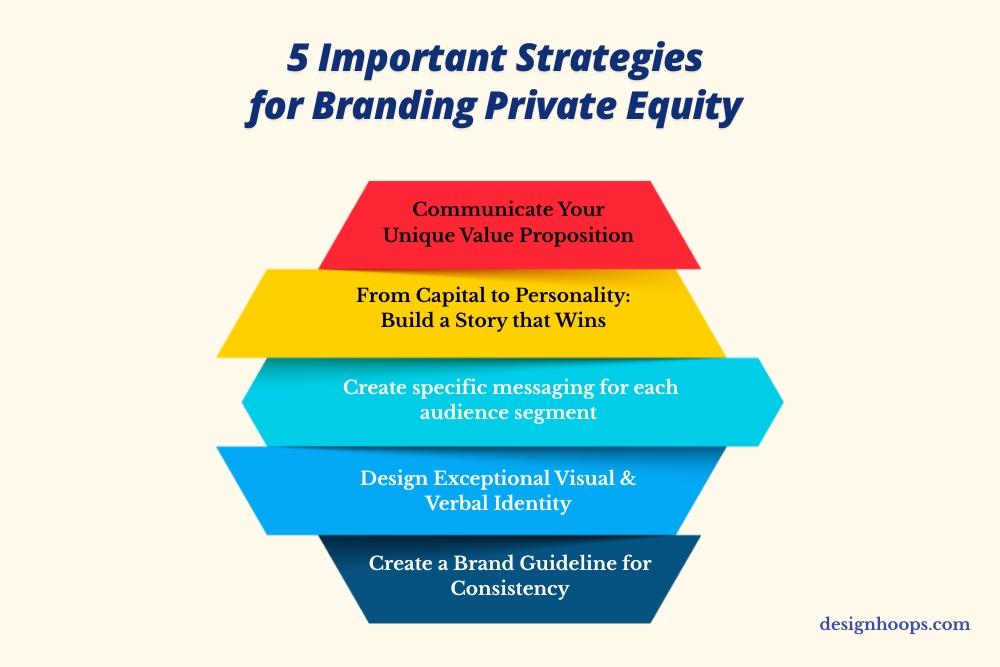
Powerful branding makes that first impression compelling, turning LPs, founders, and top talent into eager visitors, then loyal partners. Therefore, craft the following critical aspects of private equity brand strategy to outsmart the competitors.
1. Communicate Your Unique Value Proposition
This is beyond your firm’s generic claims, as you must be specific in “What do you do that no one else can do quite the same way?” So define your unique, credible investment thesis with exact precision.
One of the well-known private equity branding examples is Thoma Bravo. It is a leading private equity firm in software & technology, which doesn’t simply say it is the “technology” investor.
This firm defines them as the leading investor in enterprise software that creates superior value. They have deep, repeated expertise in buying, optimizing, and scaling software companies.
2. From Capital to Personality: Build a Story that Wins
Why do you exist beyond generating returns? The answer is your story.
Shape a clear story that communicates a compelling investment opportunity by highlighting a significant problem.
Then introduce your firm’s unique solution, a strong team, a clear path to value creation, and a credible path to exit.
That builds a meaningful connection with your desired audience.
Like Thoma Bravo, the narrative isn’t just about returns; it’s about being expert operators within the software business model.
They talk about their “playbook” for increasing growth, focusing on metrics like recurring revenue, customer retention, and upsell opportunities.
3. Create specific messaging for each segment of your audience.
You can’t come up with a generic message for everyone. As a private equity firm, you have a different group of audiences, such as investors, sellers, and management teams.
Your messaging must be clear and resonate differently with each key group.
Clarity in messaging speeds up the trust-building process, enables better deal flow from intermediaries, and builds a connection with investors.
As a result, you create a unique spot in the minds of stakeholders.
Look how the authority brand, private equity firm Thoma Bravo, brings the audience a message.
- For investors (LPs): Their message is about disciplined expertise and phenomenal returns. Their track record in software is their proof.
- For Founders (Sellers): Thoma Bravo’s message is, “They don’t just buy companies; they buy company vision as they partner with existing management teams to take the company toward success. This is incredibly appealing to founders worried about a PE firm mismanaging their technical product or company culture.
- For Technology Customers: The firm reassures customers that it invests in innovation for the long term. All to strengthen the products you rely on, ensuring your partnership grows more valuable.
4. Design Exceptional Visual & Verbal Identity
Your strong visual identity is a strategic asset for your private equity. When you create stunning and unique visuals that belong only to your firm, it makes your abstract values real to LPs, founders, and talent.
Therefore, illustrate the following five core elements of visual identity to attract your ideal audience and build a positive reputation.
1. Logo & Mark
Private equity logos are the primary look of firms that the audience sees first.
So, make sure it expresses stability, professionalism, and a modern sensibility. Avoid anything overly playful or complex that makes you look suspicious.
The logo you design must be simple, unique, and memorable, reflecting your firm’s values. Additionally, it must be readable and compatible across various applications.

For instance, the Thoma Bravo logo has two “Partnership Pillars” that show solid partnership, strength, and collaboration.
The left pillar portrays history that reflects trust, stability, and approachability.
On the other hand, the right pillar symbolizes the firm’s future that mirrors innovation, focus, and growth.
2. Color Palette
Colors also impact your audience’s mind, so choose them wisely. For private equity, you can select shades of blue, green, gray, and gold to build trust and display growth. In addition to primary colors, use secondary colors to add depth to your design.
And limit the palette to 2-3 core colors to maintain a clean, powerful, and professional appearance. Also, use these colors consistently across all materials.
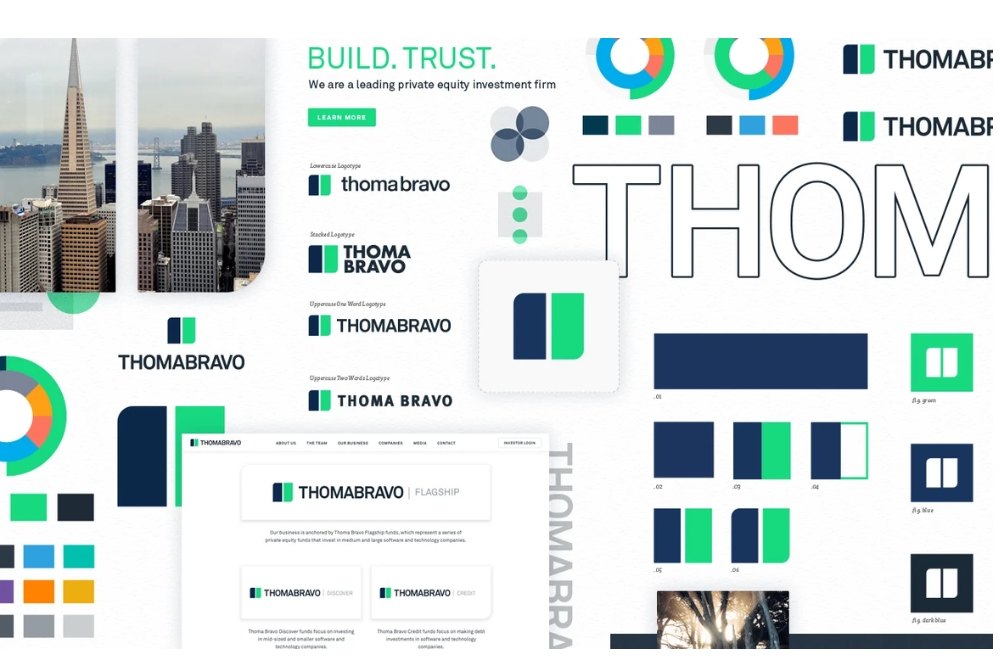
Like Thoma Bravo’s pick of brand colors, which reflects their past and future, while Thoma Bravo’s blue highlights trust and stability, the new tech green shows innovation and growth.
3. Typography (Fonts)
You must opt for the specific fonts used for headlines, body text, and presentations, as they also create an influence on your audience.
Like sans-serif fonts typically feel more modern and accessible, serif fonts can feel more established and traditional. Meanwhile, the choice should reflect your firm’s personality.
4. Imagery & Graphics
The style of photographs, icons, data visualizations, and graphic elements is a critical aspect of your brand visual.
Other than that, avoid using generic stock photos. Only, use authentic images of your team, portfolio company operations, or abstract imagery that reflects your sector focus.
Moreover, utilize icons and charts that are clean, simple, and consistent in style (e.g., line icons, flat design).
5. Brand Tone & Voice
Your verbal brand voice and tone must resonate with the visual tone. Find out if your language is authoritative and direct or collaborative and visionary. The words on your website and in your pitch decks must match the values and clarity of your visual design.
Like Thoma Bravo’s brand voice is strategic and authoritative, yet approachable and collaborative, while the tone is bold, confident, and professional, focusing on its expertise in software and technology investments.
5. Create a Brand Guideline for Consistency
Your defined brand identity is useless without strict consistency. It must be applied uniformly to everything:
- Website & Digital Presence
- Pitch Decks & Teaser Documents
- Investor Reports
- Office Environment
- Recruitment Materials
Therefore, create a brand guideline that your team can look at and consistently follow the same rules everywhere.
In a nutshell: You must develop a private equity brand strategy, messaging, and visual elements that are memorable, credible, and distinct.
Because it silently communicates your firm’s professionalism and strategic focus long before a single meeting is held.







Discussion about this post